DeepSeek-V4-Flash Beats GLM, Nears Opus 4.8 at a Lower Price
DeepSeek-V4-Flash reaches 82.7 on Terminal-Bench 2.1, beats GLM-5.2, approaches Claude Opus 4.8, and costs just ¥1 input / ¥2 output per million tokens for agents.
Published 50 days ago. Content may be outdated.
The production release of DeepSeek-V4-Flash is here.
On July 31, DeepSeek announced in its API changelog that the official DeepSeek-V4-Flash API is now in public beta. The main upgrade is not a larger architecture. It is a new post-training run focused on making the Flash model much better at agentic work.
For developers, this may be one of the most important DeepSeek API updates to test right now.
What changed?
The short version: DeepSeek-V4-Flash is now publicly available through the API, with a major focus on agent performance.
DeepSeek highlights three points:
- Much stronger agent capabilities, with several benchmarks well ahead of V4-Pro-Preview
- Native Responses API support, with specific adaptation for Codex
- The same architecture and size as DeepSeek-V4-Flash-preview, with the main change coming from post-training
DeepSeek is not selling this release as “more parameters.” The focus is more practical: better tool use, longer task execution, and stronger performance in coding-agent workflows.
Official benchmark results
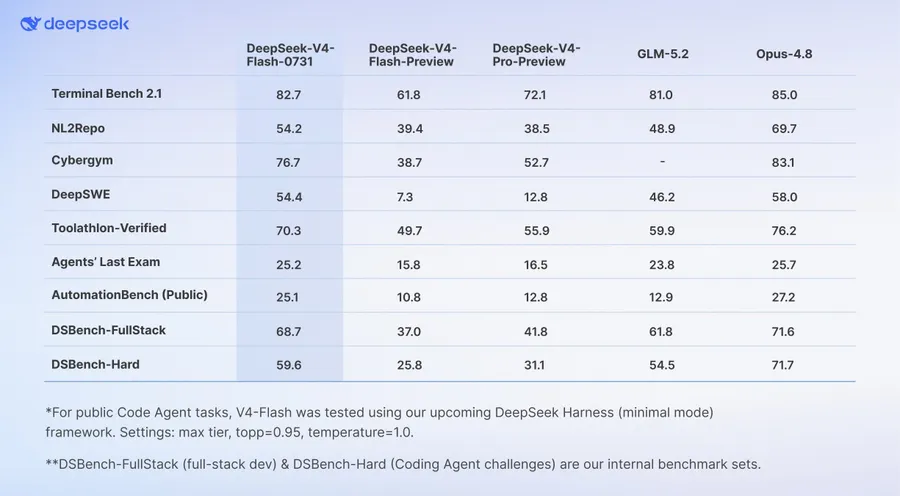
DeepSeek published nine results for the production V4-Flash across agent, coding, and tool-use tasks:
| Benchmark | DeepSeek-V4-Flash |
|---|---|
| Terminal-Bench 2.1 | 82.7 |
| NL2Repo | 54.2 |
| CyberGym | 76.7 |
| DeepSWE | 54.4 |
| Toolathlon verified | 70.3 |
| Agent Last Exam | 25.2 |
| AutomationBench (Public) | 25.1 |
| DSBench-FullStack | 68.7 |
| DSBench-Hard | 59.6 |
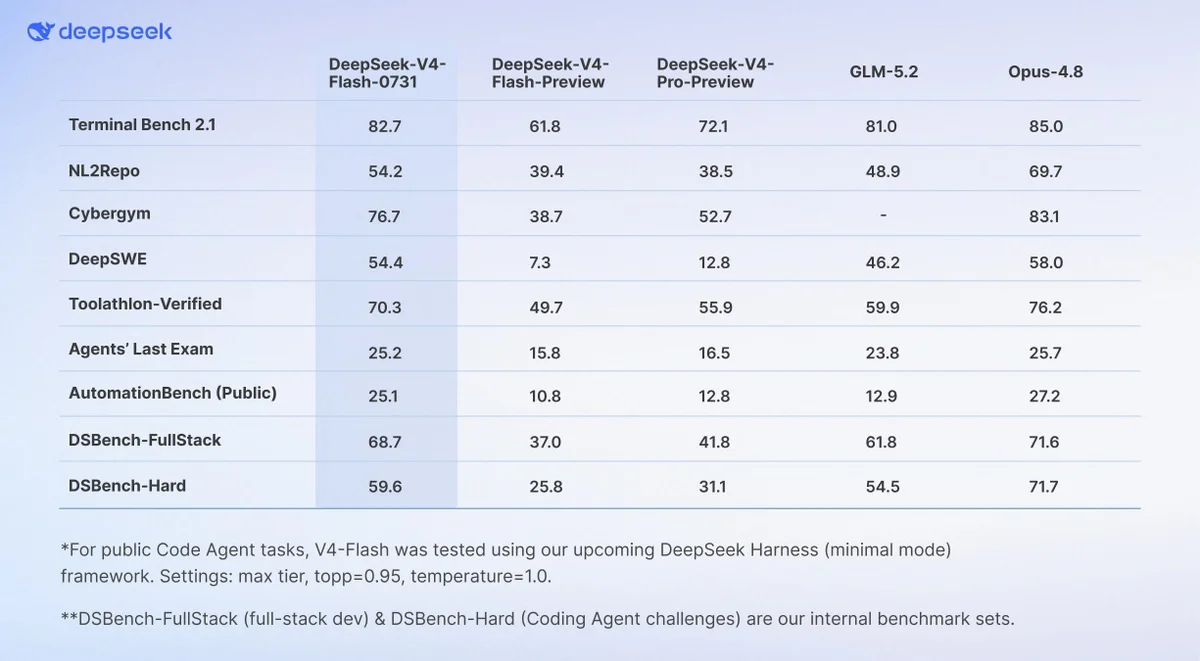
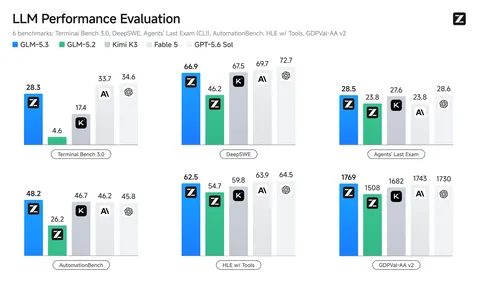
Official DeepSeek-V4-Flash benchmark results compared with other models.
Together, these tests cover terminal execution, repository generation, cybersecurity, software engineering, tool use, long-horizon professional workflows, and full-stack development. The scores use different tasks and scales, so they should not be added together into a single “overall score.”
It beats GLM first
The clearest comparison is Terminal-Bench 2.1: DeepSeek-V4-Flash scores 82.7, compared with 81.0 for GLM-5.2. That is a 1.7-point lead on the same benchmark.
This is not a vague claim about one domestic model versus another. It is a public result on the same test. V4-Flash has moved ahead of GLM-5.2, and it is beginning to approach the high-end agent capability range associated with Claude Opus 4.8.
That does not mean a clean sweep over Opus 4.8. Harnesses, reasoning settings, tool permissions, and benchmark versions can differ. The defensible claim is that V4-Flash is moving into the same performance conversation, not that it wins every task.
The price gap is the sharper story
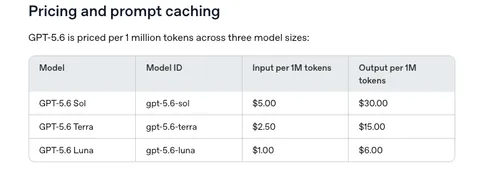
DeepSeek’s official API pricing for V4-Flash is ¥0.02 per million input tokens with cache hits, ¥1 per million uncached input tokens, and ¥2 per million output tokens.
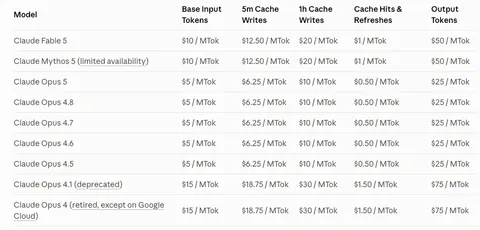
Claude Opus 4.8 is listed at $5 per million input tokens and $25 per million output tokens. For agents that run long loops and call tools repeatedly, that difference compounds with every step.
GLM users also got a timely reminder that performance and pricing are separate competitions. Z.ai’s July 30 announcement revised the GLM Coding Plan. The current page lists continuous monthly prices of ¥94.4 for Lite, ¥430.4 for Pro, and ¥862.4 for Max. The announcement lists the previous V2 prices for Pro and Max as ¥149 and ¥469.
Fans of GLM can certainly keep supporting it. The support now looks a little like reinforcement learning for the billing system: the models are still competing on benchmarks, while the subscription has already scaled up its context window. V4-Flash is catching up to, and in some tests passing, GLM while GLM’s coding plan is getting more expensive. Developers were bound to notice that contrast.
Why Flash matters
V4-Pro is meant to define the ceiling. Flash is meant to operate at scale.
A Flash model does not need to beat every flagship on the hardest task. Its real value is becoming the default for a large volume of practical work: writing code, running scripts, inspecting a repository, editing files, generating documents, calling tools, and handing tasks to a Codex-style environment.
The important signal is that DeepSeek is training Flash as a primary agent-workflow model rather than positioning it only as a cheaper fallback.
That is why the post-training change matters. In an agent workflow, the model must continuously decide what to inspect, which tool to call, and whether the task is actually complete. Better post-training can improve those decisions more directly than simply increasing model size.
Codex users should pay attention
DeepSeek explicitly says that the production V4-Flash supports the Responses API natively and is adapted for Codex.
The coding-agent competition is no longer just about generating a function. It is about accepting a real repository task, understanding context, editing files, running tests, recovering from failures, and delivering a result.
If V4-Flash can perform reliably in that loop, this release matters much more than a routine API model refresh.
What has not changed?
There are clear boundaries to this release:
- Only the DeepSeek-V4-Flash API was upgraded
- The DeepSeek-V4-Pro API was not changed
- The DeepSeek App and Web models were not changed
- The official DeepSeek-V4-Pro release is still to come
This is not a full product-line upgrade. To use the new model, developers need to call the API.
The takeaway
The important part of DeepSeek-V4-Flash is not the word “Flash.” It is that a lower-cost model is becoming a more capable agent executor.
Developers care less about whether a model merely understands a task and more about whether it can finish one. DeepSeek has put the upgrade effort into agents, the Responses API, and Codex integration. The direction is unambiguous.
The practical next step is to rerun existing coding-agent, automation, and tool-use workloads. Some execution steps that previously required a more expensive model may now be good candidates for DeepSeek-V4-Flash.
Sources:
More Articles