FFmpeg 9.0 "Lei" Is Here: A Tribute to Lei Xiaohua, Ten Years Later
FFmpeg 9.0 "Lei" is officially released with new LCEVC, Animated WebP, Vulkan, CUDA, AMF, and professional video capabilities. The codename honors Chinese multimedia developer Lei Xiaohua on the tenth anniversary of his death.
Published 45 days ago. Content may be outdated.
FFmpeg 9.0 is officially here. The release brings a new wave of codec, muxer, filter, and hardware-acceleration updates. But more moving than any individual changelog entry is the name it chose for itself: Lei.
”Lei” is not a codec or a hardware platform. It is the surname of Chinese multimedia developer Lei Xiaohua. FFmpeg 9.0 uses the name as a tribute to him.
What Is the Status of FFmpeg 9.0?
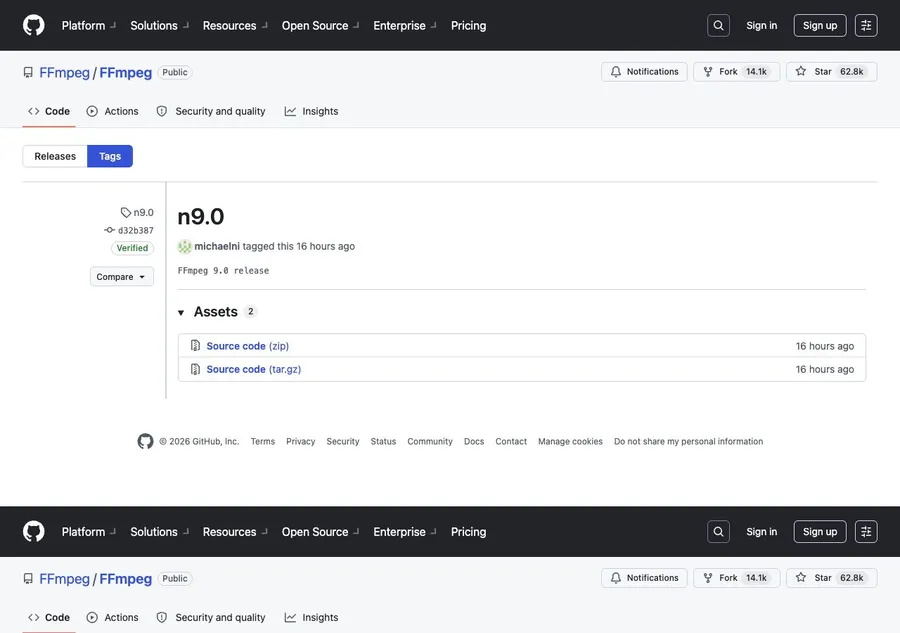
The FFmpeg download page lists 9.0 as the latest stable release. Its corresponding source tag in the official GitHub repository is n9.0.
The two labels serve different purposes:
- FFmpeg 9.0: the formal version number used by users and distributions
- n9.0: the source tag used in the official FFmpeg Git repository
Here, n is not a nightly-build or special-distribution marker. It is part of FFmpeg’s established source-tag naming convention.
The official Git tag page shows August 3, 2026, while the download page lists August 4, 2026, as the release date. Either way, 9.0 is now a stable release.
What Has Changed?
The official Changelog places the main work in format support, filters, and hardware acceleration.
Containers and Formats
- MP4 muxing support for LCEVC tracks
- A new Playdate video encoder and muxer
- SMPTE 2094-50 metadata support and pass-through
- A bitstream filter for splitting multilayer Dolby Vision HEVC
- An Animated WebP decoder and demuxer
- HE-AAC 960 decoding for DAB+ use cases
Hardware Acceleration and Filters
- A new
v360_vulkanfilter - A new
transpose_cudafilter - An AMD AMF Frame Rate Converter filter
- Expanded HDR capabilities in the AMF Color Converter
- ProRes RAW VideoToolbox hardware acceleration
- APV Vulkan hardware acceleration
- AMF hardware-memory mapping support
- GPU Execution Provider support for the ONNX Runtime DNN backend
Taken together, these changes push FFmpeg further into new formats, GPU-accelerated processing, and professional video workflows.
Compatibility Changes
FFmpeg 9.0 also removes or cleans up some older support:
- Standalone CELT decoding is removed, without affecting CELT inside Opus
- Ogg/CELT parsing is removed
- Some deprecated NVENC options are removed
- Parts of NVENC support tied to SDK versions older than 11.1 are no longer supported
Before upgrading, check legacy NVENC parameters, standalone CELT decoding, Ogg/CELT parsing, and external SDK versions in build scripts. Whether common MP4, H.264, H.265, AV1, and AAC workflows are affected still depends on the actual build and its dependencies.
Why “Lei”?
FFmpeg has often used the surnames of computer scientists, mathematicians, and other notable figures for its release codenames. That makes “Lei” easy to mistake for the name of another scientist.
This time, “Lei” means Lei Xiaohua.
For Chinese multimedia developers, Lei Xiaohua was more than a GitHub username. He spent years organizing tutorials and examples covering FFmpeg APIs, source-code analysis, audio and video codecs, containers, and streaming protocols. He took difficult, scattered technical knowledge and broke it down into material that later developers could read and run.
His leixiaohua1020 GitHub account and personal website became places many Chinese developers returned to while learning FFmpeg. His examples, source notes, and introductory articles helped many people take their first real steps into multimedia development.
Lei Xiaohua died in 2016. FFmpeg 9.0 arrives in 2026, the tenth anniversary of his death. By choosing “Lei” as its release codename, the project feels as if it has left a late but solemn message inside a new version: thank you for lighting the way for those who came after you.
FFmpeg 9.0 “Lei” is therefore more than a new version number. It continues to add LCEVC, Vulkan, CUDA, and AMF capabilities while writing the name of a Chinese multimedia developer into the project’s history.
How Should the Version Number Be Read?
FFmpeg version numbers should not be treated as strict semantic-versioning identifiers.
For example, the official repository contains tags such as n8.1.2, n8.0.3, and n7.1.5. The final number distinguishes maintenance releases, while 9.0 identifies the new formal release branch.
The practical question is what 9.0 changes in the workflows that matter: codecs, decoders, filters, external SDKs, hardware encoders, and build parameters. Upgrade testing should focus on those details instead of judging compatibility from the version number alone.
Finally
FFmpeg 9.0 “Lei” brings LCEVC, Animated WebP, Vulkan, CUDA, AMF, ProRes RAW, and Dolby Vision updates, while also placing Lei Xiaohua’s name in FFmpeg’s version history. The technical work shows that the project is still moving forward; the codename gives this release a memory that belongs to the developer community.
For projects preparing to upgrade, start with the official Changelog and run regression tests for hardware encoding, legacy parameters, and external SDKs. As for “Lei,” it is no longer just a release codename. It has become FFmpeg’s way of saying hello to Lei Xiaohua once again.
Sources:
More Articles