Jina Embeddings v5 Omni: One Vector Space for Text, Images, Video, and Audio
Jina Embeddings v5 Omni maps text, images, video, and audio into one shared vector space for multimodal search, clustering, recommendation, and RAG retrieval workflows across media.
Published 126 days ago. Content may be outdated.
Embedding models used to be mostly modality-specific. Text had one model, images had another, while video and audio were often split, transcribed, or converted before retrieval.
Jina Embeddings v5 Omni has a cleaner goal: one multimodal embedding model that maps text, images, video, and audio into a shared vector space.
The important part is not just that it accepts more input types. It makes different media directly comparable for retrieval, clustering, recommendation, and multimodal RAG.
Quick Summary
- Modalities: text, images, video, and audio
- Core idea: map different media types into a shared embedding space
- Search patterns: text-to-image, image-to-video, audio-to-content, and more
- Model family: Jina v5 Omni multimodal embedding model
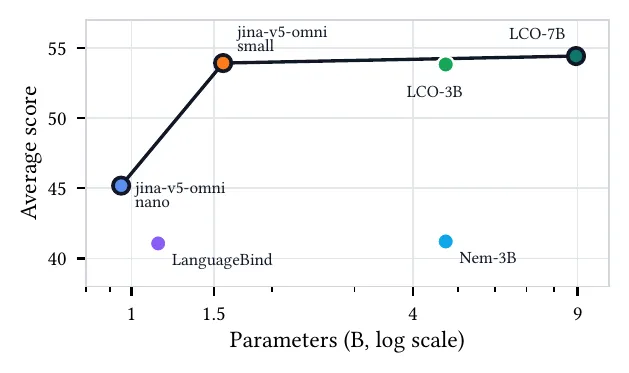
- Variants: small and nano, balancing quality and deployment cost
- Use cases: semantic search, clustering, deduplication, recommendation, multimodal RAG
In one sentence: it moves embeddings from text vectors toward unified media vectors.
The real problem is not media support. It is comparability.
Many multimodal search systems look impressive at the demo layer, but are messy underneath.
A company knowledge base may contain product docs, training videos, meeting recordings, design screenshots, and support conversations. The usual approach is to index every media type separately and merge the results later.
That creates hard questions:
- How do you compare scores across indexes?
- How do you rank a video segment against a document paragraph?
- Which pipeline should a short user query trigger?
- How much custom fusion logic do you need to maintain?
Jina Embeddings v5 Omni matters because it pushes these media types into one comparable space.
That means a text paragraph, an image, a video clip, or an audio segment can all become vectors for similarity search, clustering, recommendation, and cross-modal retrieval.
Why one vector space matters
Vector search depends on comparable similarity scores.
A 0.82 score from a text model and a 0.82 score from an image model are not necessarily equivalent. If you merge them naively, ranking quality can become unpredictable.
A shared embedding space makes cross-modal retrieval more natural.
That helps in three practical scenarios:
- Media asset search: type “rainy neon street” and retrieve images, videos, and sounds
- Enterprise knowledge search: one question can retrieve docs, recordings, videos, and screenshots
- Content recommendation: use a liked video to find related articles, images, and audio clips
These systems were possible before. The difference is that the underlying retrieval path can now be much less fragmented.
How it relates to Jina Embeddings v5 Text
jina-embeddings-v5-omni extends the Jina Embeddings v5 family rather than replacing it with a separate multimodal stack.
That matters because multimodal search still relies heavily on text quality. If a model supports image, video, and audio but weakens text retrieval, enterprise search and RAG systems become harder to trust.
The direction here is pragmatic: keep the text embedding foundation strong, then align other media types into the same semantic space.
Small and nano: cost matters
Jina Embeddings v5 Omni comes in small and nano variants.
That is not just packaging. It reflects the reality of production search systems.
- small is better suited for quality-sensitive retrieval
- nano is better suited for cost-sensitive, latency-sensitive, or large-batch workloads
This matters a lot for audio and video. Once you start embedding millions of media assets, model cost and throughput become as important as benchmark quality.
A great embedding model that is too expensive to run at scale is not an infrastructure model. It is a demo.
What can it plug into?
The model outputs embeddings, so the downstream system can be a vector database, a recommendation engine, an enterprise search stack, or a custom retrieval pipeline.
The point is that different media can share one semantic representation.
That makes several downstream tasks easier:
- cross-modal similarity search
- multimedia clustering
- deduplication and near-duplicate detection
- retrieving media evidence from text queries
- first-stage retrieval for multimodal RAG
Practical usage pattern
A realistic workflow looks like this:
- Encode text, images, audio, and video segments into embeddings
- Store vectors plus metadata in a vector database, recommendation system, or custom retrieval system
- Let users query with text or media inputs
- Retrieve across one shared vector space
- Rerank with metadata, recency, permissions, or business signals
- Pass selected results into a RAG or recommendation layer
For example, a user might ask: “Where is the green dashboard screenshot from last week’s product launch?”
The system can retrieve:
- the relevant video segment
- the meeting recording or transcript
- the product screenshot
- the matching documentation paragraph
That is where multimodal embeddings become useful: they reduce the cost of searching across scattered media assets.
What it does not solve
Jina Embeddings v5 Omni is not a complete application system by itself.
You still need to handle:
- video segmentation
- audio chunking
- document permissions
- metadata filtering
- reranking
- duplicate cleanup
- bad or low-quality source data
- answer grounding in RAG systems
Embedding models decide what gets retrieved. They do not guarantee that the final answer is correct.
The uncomfortable truth is simple: multimodal embeddings can unify semantic space, but they cannot fix poor data governance.
Final take
Jina Embeddings v5 Omni is worth watching because it pushes embedding models from single-modality vectors toward one shared media semantic layer.
For developers, that means one model can cover more media types.
For enterprises, it means documents, images, recordings, and videos can be represented through the same vector model.
For RAG systems, it means knowledge bases are no longer limited to text. Training videos, meeting audio, screenshots, and design assets can all become retrievable context.
If you are building enterprise search, media search, customer support retrieval, or multimodal RAG, this model is worth testing.
Links
More Articles